
April 8, 2026
What I tell golfers in the first month of the Okanagan season
A Vernon chiropractor on the patterns that show up every spring at Predator Ridge, Vernon GCC, and The Rise — and what actually works to play more golf with less pain this season.
By Dr. Steve Hofmann · Chiropractor
Every May, the same week the Okanagan courses fully open, the same patients come through the clinic. The shoulder that “just felt off” after the first 18 at Predator Ridge. The low back that locked up after a Saturday at Vernon GCC. The trail elbow that wasn’t a problem last summer and now it is.
If you play golf in this valley and you’d like to play more of it this season — without watching it from the cart by July — here’s what I actually tell people. No injury checklist. Just the patterns I see every spring and what actually helps.
The honest truth about “golf shape”
Most amateur golfers in the Okanagan have a four-month off-season. November through March, the body does mostly desk-and-couch with maybe some skiing or treadmill work. Then mid-April hits, the courses open, and the body is asked to perform a high-rotation, ground-loaded, decelerative sport for 4–5 hours at a stretch.
That gap — between what the body has been doing and what the swing demands — is the single biggest predictor of who’ll be in clinic by Mother’s Day.
The fix isn’t dramatic. It’s about the first six weeks. If you build into the season instead of jumping straight to your June handicap, the body catches up and most of the injuries don’t happen.
The six-minute warmup that does more than the bucket of balls
The biggest mistake I see is the “I’ll just hit a small bucket to warm up” approach. Banging 30 balls cold isn’t a warmup. It’s the first 30 swings of your round, with cold tissue.
A proper warmup is short, structured, and gets the system actually ready to swing:
- Two minutes of walking — get the heart rate up, blood flowing
- Hip circles, both directions — 10 each leg
- Thoracic rotations with a club across the shoulders — 10 each side
- 10 bodyweight squats — primes the glutes, which most desk-workers have forgotten about
- A few half-speed practice swings, then build to full
Two of those are worth a closer look — they’re the moves most amateurs either skip or do wrong.
Hip circles
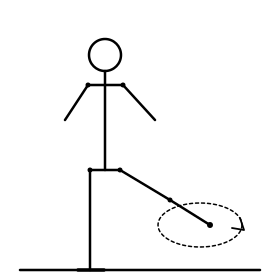
Stand on one leg, lift the other knee up and out, and draw slow circles with the foot — both directions. The hip is the joint that’s supposed to do most of the rotating in a golf swing. This wakes it up.
Thoracic rotations with a club
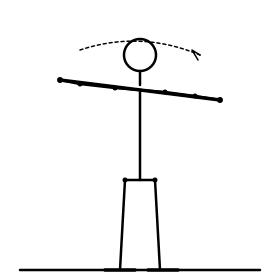
Hold a club across the back of your shoulders, hands on the ends, and rotate your torso side to side. Keep the hips relatively still — the goal is to free up the upper back, not just spin the whole body. This is where most amateurs are stuck and why their lumbar spine ends up doing the rotating it shouldn’t.
Do all of this and you can absolutely hit a few warm-up balls — they’ll just be quality reps instead of cold ones.
Grip pressure is the elbow problem nobody talks about
If you’re getting golfer’s elbow (medial side) or tennis elbow (lateral side) and your grip is tight, that’s almost always the entry point. White-knuckling the club through 70 swings on a Saturday is six hours of static forearm load. Eccentric exercises help. Soft-tissue work helps. But if the grip pressure doesn’t change, you’re treating downstream of the actual problem.
Sam Snead used to talk about gripping the club like you’d hold a small bird — firmly enough that it doesn’t fly away, gently enough that you don’t crush it. It’s still the best instruction I’ve heard. Your grip pressure should be a 3 or 4 out of 10 through the swing — not the 8 or 9 most amateurs default to under pressure.
The walking 9 vs cart 18 conversation
I have this conversation with patients every May. They want to play 18 because that’s “real” golf. The body, fresh out of winter, isn’t ready for 18 from a cart on Saturday and 18 from a cart on Sunday two weeks in a row.
For the first month back, walking 9 holes is genuinely better for you than 18 in a cart. You move more (golf walking burns 1500+ calories), the hips and back load and unload progressively instead of stiffening between holes, and you can actually feel what your body is telling you. By June, your aerobic and structural baseline have caught up and you can ramp into the longer rounds.
What to do off the course (15 minutes, 3 times a week)
If you do nothing else, do these. They cover most of what we treat:
- Glute bridges — 2 sets of 12. The glutes are the engine of the swing and they’re asleep on most desk-workers.
- 90/90 hip rotations — 5 each side per direction. The single best mobility drill for golfers I’ve ever found.
- Thoracic openers — lying on your side in a 90-degree position, opening the top arm to the floor. 8 each side. Frees up the upper back so the lumbar spine doesn’t have to over-rotate.
- Wrist flexor and extensor stretches — held 30 seconds each side. Cheap insurance against elbow problems.
- Single-leg balance — 30 seconds each side. Boring. Effective.
Done three times a week, this is the program that keeps people on the course. There’s no magic. Just dose-response.
When to come in
Most spring golf complaints respond well to a few visits if caught early. Come in if:
- You’ve got pain limiting your swing
- A specific area (low back, elbow, shoulder, wrist) hasn’t settled within a week
- Something has been “off” since the first round and isn’t getting better
- You’re noticing yourself protecting an area or compensating
Come in sooner if:
- You’re getting numbness or weakness anywhere
- Your back or neck pain has changed quality (sharp-shooting vs achy)
- A wrist injury isn’t tracking the way you’d expect
We treat a lot of golfers — most of what we see is a patterned, fixable problem rather than something structurally serious. The earlier we catch it, the simpler the recovery and the more golf you get to play.
The thing about your handicap
Final note: your handicap from last year will come back. It comes back faster if you don’t spend three weeks in a knee brace or a shoulder sling. Build into the season, do the boring 15-minute home program, walk the front 9 in May. The June, July, and August versions of you will thank you.
And if something does flare up — call us. We can usually get it sorted faster than you think.
Related
General information only — not medical advice and not a substitute for assessment by a qualified health professional. If you have specific concerns about an injury or symptom, book a consultation or contact your healthcare provider.
Need to be seen?
Book online or give us a call.