
April 25, 2026
What we tell our pickleball patients (you know who you are)
A Vernon chiropractor on the typical pickleball patient — playing five days a week, can't stop, doesn't want to stop — and what actually keeps you on the court.
By Dr. Steve Hofmann · Chiropractor
The typical pickleball patient I see is somewhere between 55 and 70, plays five or six days a week, has been playing for two or three years, can name everyone at their morning court, and absolutely does not want to be told to take time off.
This article is for that person. (You probably know who you are.)
If you’ve found a sport in your sixties that you love this much, the goal isn’t to play less. It’s to play smarter so you can play more. Here’s what we actually tell our pickleball patients.
The first thing nobody wants to hear
Pickleball is addictive in a way that most adult sports aren’t. The skill ceiling is achievable, the social loop is fast, the games are short, and the people are usually great. So you play Monday. Then Tuesday. Then Wednesday. Then by Thursday your calf is talking to you, and you tell yourself you’ll go easy at Friday’s session, and then Friday you’re playing your best pickleball in months and you push.
That cycle is the single biggest cause of pickleball injuries we see. Not bad mechanics. Not bad equipment. Just too much, too consistently, with no off days.
Adult tissue — particularly Achilles, calves, plantar fascia, rotator cuff — needs recovery between high-load sessions. Skipping that recovery is the difference between “manageable tweak” and “out for six weeks.”
The simplest rule: at least one full rest day a week from pickleball. Two if you’re over 60 and playing four+ days. The rest day isn’t a failure. It’s the thing that lets you play five other days.
Shoes are not optional
This is the thing most players are wrong about. Running shoes — or worse, walking shoes — are not designed for the lateral movement that pickleball demands. They’re built for forward gait, with soft heels and minimal lateral support. Wear them on a pickleball court and you’re at meaningfully higher risk of ankle rolls, knee stress, and Achilles trouble.
You want court shoes — tennis shoes, pickleball-specific shoes, or volleyball-style indoor shoes (depending on surface). Lower to the ground, lateral support, designed to handle quick stops and direction changes.
If you’ve been wearing running shoes on the court for a year and feeling fine, you’re getting away with it. Most people don’t, indefinitely.
The kitchen-line trip
The most common acute injury we see in pickleball isn’t from a swing — it’s from the feet. A player at the non-volley line lunges for a low ball, the back foot slides where it shouldn’t, and they go down with a hand out to catch themselves. The result is usually a wrist sprain, sometimes a fracture (the small scaphoid bone in the wrist is especially easy to break and easy to miss without imaging).
The fix is a habit. Two of them, actually:
- Don’t backpedal. Turn and run. Backpedaling for a lob is how players go down hard.
- Stay aware of where your back foot is. Particularly at the kitchen line. Cluttered foot positioning is what catches people out.
If you do go down on a hand: don’t assume it’s “just bruised.” Wrist injuries from falls are routinely missed and routinely worse than they look. Get assessed.
The volume problem in plain terms
The healthiest pickleball players we see do something close to this:
- 3 to 4 days of pickleball a week
- 1 day of strength or cross-training (walking, cycling, swimming, gym work)
- 2 days of genuine rest or low-impact movement
- A pre-game warm-up every single time
- Stretches for the calves, hip rotators, and forearms after play
- A real off-day after any pickleball session that felt unusually hard
Players who play five and six days a week without strength work eventually break down. It’s just a question of where — Achilles, calf, knee, shoulder, low back — and when.
Stretches that actually move the needle
Most “after-pickleball stretches” online are general. Here are the ones we’d prioritize for the demands this sport actually places on the body. Five minutes after every session — better than nothing, which is what most players are doing.
Calf stretch
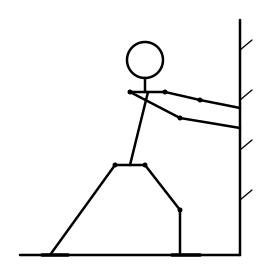
Both straight-leg (gastrocnemius) and bent-knee (soleus). 30 seconds each, both legs. Most pickleball calves are tight from constant push-off.
Hip rotator stretch
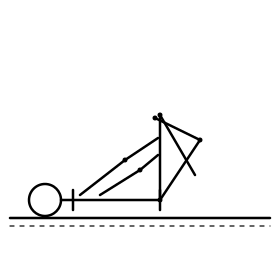
Lying on your back, rest one ankle on the opposite knee — your legs make a rough number-4 shape — then reach behind the bottom thigh and pull it toward your chest. 30 seconds each side.
Wrist flexor stretch
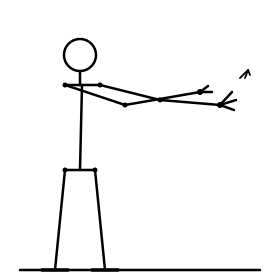
Arm out, palm up, gently pull fingers down with the other hand. 30 seconds each side. Cheap insurance against pickleball elbow.
Doorway pec stretch
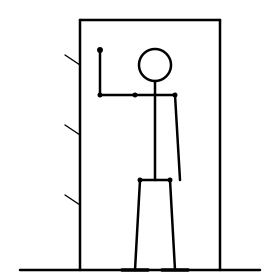
Stand in a doorway with one arm bent at 90 degrees, forearm pressed against the door frame. Lean gently forward until you feel the stretch across the front of the chest and shoulder. 30 seconds each side.
Standing IT band stretch
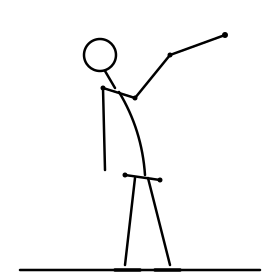
Cross one leg behind the other, reach the same-side arm overhead, and lean toward the opposite side. 30 seconds each.
Strength work nobody wants to hear about
Two exercises that, done twice a week, prevent more injuries than any stretching routine:
- Single-leg calf raises. Stand on one leg, raise up, lower slowly. 2 sets of 10 each leg. Build the calf and Achilles capacity to handle hundreds of push-offs without tearing.
- Glute bridges or step-ups. Strong glutes control the hip and the knee. Most knee pain we see in pickleball players is actually a hip problem the knee is paying for.
Twenty minutes, twice a week. That’s it. The players who do this are the players who keep playing into their 70s.
When to come in
For pickleball stuff, the rule is: if it’s not settling within a week, come in. If it’s actively limiting your play, come in. If you’ve had a fall and something doesn’t feel right, come in.
We see a lot of pickleball patients. We treat them in a way that’s specifically designed to keep them playing — early, focused, with a real rehab program built around the actual demands of the sport.
The point
You don’t have to choose between playing pickleball and being healthy. The “play hard, ignore the body, hope for the best” strategy doesn’t work past 50, even when you’ve gotten away with it for a while.
Take a rest day. Wear court shoes. Do the calf raises. Stretch after sessions. Come in when something’s off.
Then play your six days. Vernon’s pickleball season runs basically year-round between indoor and outdoor courts. Plenty of court time ahead — let’s keep you on it.
Related
General information only — not medical advice and not a substitute for assessment by a qualified health professional. If you have specific concerns about an injury or symptom, book a consultation or contact your healthcare provider.
Need to be seen?
Book online or give us a call.